The Gear - Part 3 - Shelter & Tools
Tuesday, Jan 22, 2019 | 9 minute read | Updated at Tuesday, Jan 22, 2019
Shelter
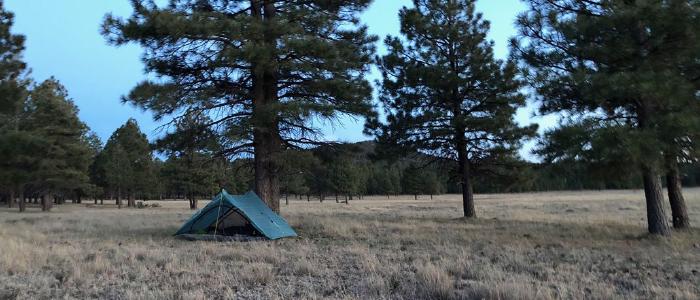
My first tent, purchased in July for a 4 day backpacking trip, was an MSR Hubba Hubba NX: a 2-person tent. I had just learned about REI, and the review sites said this was a great tent - the perfect middle of the road. It was freestanding, and easy to set up; I loved it.
I then acquired the 1-person version: The MSR Hubba NX. I love it as well, until I realized that at 3.5 pounds, and that was far too heavy.
I proceeded to look for other options, and it’s that research which led me to discover that thru-hiking was a thing, and eventually led to the Arizona Trail.
Because I’m shiny, I was drawn to the most hipster company in the tent industry: Zpacks. They sell DCF tents, an extremely lightweight fabric that is waterproof, breathable, and does not absorb moisture of any sort.
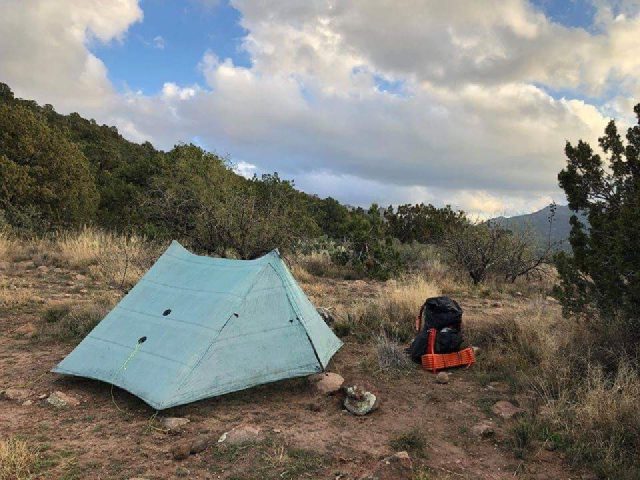
The tent I decided on was the Zpacks Duplex, a 2 person tent that weighs 19 ounces. With stakes and a slightly thicker version of DCF, my tent weighed 20.5 ounces. Compared to the MSR NX2 at 60.8 ounces, well, there is no comparison. It’s much better.
I loved the Duplex at first. It’s clean, lightweight, and it gave the impression that I knew what I was doing. It weighs less than most 1 person tents, and as a 2 person tent, is quite spacious for 1 person. It required 2 trekking poles, and a well-staked, extremely taught pitch. It is, however, a bit finicky, and often required 5-10 minutes to get set up properly.
In good soil conditions, it’s great.
In very rocky soil conditions…it’s almost useless.
As I got farther south, I ran into more and more problems, and I began to hate it. It’s not the tent’s fault - it’s that the tent is made for ideal soil. Often, I would have a campsite that only allowed the stakes to be driven in for 3” or less. Past that, there was apparently a solid sheet of rock that prevented any kind of taught pitch.
Without a perfect pitch, the Duplex becomes an awful blanket.
In addition, because it’s a single wall tent, condensation forms on the inside of the tent when the vestibule doors are closed. This was expected, but I didn’t quite understand why there would be lots of condensation one night, and not very much on another, even though it was the same temperature.
I learned later that there are lots of weather factors, including humidity , dew point, and wet bulb temperature. At the time, it was just confusing.
To the Duplex’s credit, condensation never dripped on me. It slid down the inner wall and onto the ground. Always. Even when snow formed on the inside of the tent, it never came down on me unless it was purposefully disturbed.
The problem: sometimes my quilt would rub up against the edge of the tent and the foot box would become wet; it was a continual source of stress. I ended up sleeping diagonally, but you move during the night, and you’re always wondering if a lot of water is soaking into the quilt. You wouldn’t know until it was too late, and this kept me from sleeping soundly some nights. I would use my rain jacket to wrap the foot box, but that would often come off while I was sleeping.
The Duplex, although very roomy, was too big. I never thought it would be a problem, but there were times that I had a 30" opening, and the 45" width of the tent, not to mention the extra space necessary for guy lines and vestibules, was simply not available. Over time, as I became more efficient with my process and gear, I wanted a smaller tent.
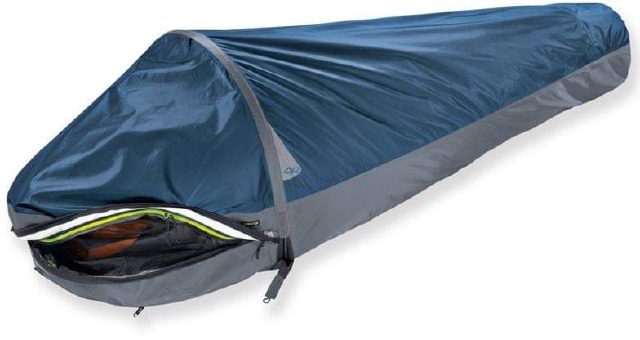
Because of the size, the bad soil conditions I ran into, and the impending danger of a snow storm, I switched to the Outdoor Research Alpine 4 season bivy. At 2 pounds, it is heavier than my two person tent, but requires no stakes, is a 4 season shelter, and is able to handle all manner of wind, snow, and rain. I was excited.
Condensation was still a problem, though. In the morning after my first night in the bivy, my quilt was more wet than it had ever been, and I could cup the water from the inner wall of the bivy in my hand.
Erk.
It was worse than the tent.
Going back to the tent would have required backtracking, so I opted to stick with the bivy, and cowboy camp for the rest of the trip.
The next night, however, I had read too much about wolf spiders, and the day had been fairly warm - warm enough to make me wonder if snakes would be around in the evening, so I climbed back into the bivy again.
I noticed there were stake loops, so I staked it out. It turned out that using stakes provided just enough tautness to provide air flow - I never had a problem with air flow again.
The problem I have with the bivy at this point is that in order to pack everything up, you have to get out of the bivy and deal with whatever weather conditions are thrown at you. With a tent, you can pack up inside the tent if it’s raining, and get out mostly ready to go.
With the bivy, you’re exposed to the elements and trying awkwardly to change and get shoes on without getting them dirty or wet from the ground. It’s problematic, and if it’s raining or snowing, you’re stuck, and potentially losing heat while you pack up. I don’t think it’s a good solution.
I’m glad I had the experience with bivy. Using it made me feel like an über hiker. Now that I understand the drawbacks, however, I will be moving back to a tent, albeit a smaller, different tent.
Tools
Trekking Poles
Most everyone I know has the Black Diamond carbon cork trekking poles. The weight of each pole, however, is just over 8 ounces. While it’s certainly much better than your average REI trekking pole, it was still too heavy for me. The lightest adjustable poles I’ve found were just under 4 ounces, but they had a twist lock, and twist locks don’t seem very reliable.
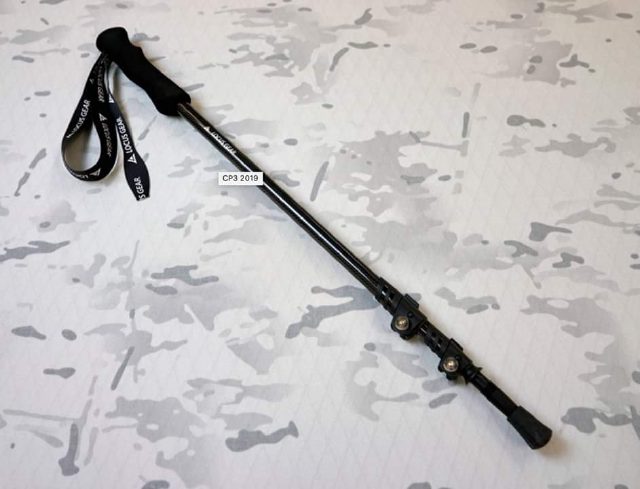
After much internetting, I finally found the Locus Gear CP3 poles. They are 5.5 ounces each, and as far as I know, they are the lightest adjustable trekking poles with a flick lock. They compact to 25", and extend to 53". I would prefer poles that compact to 12", but I haven’t found any that get that small and are adjustable. The adjustable seemed necessary because the tent requires a different length with which I walk.
I was really happy with these poles. Because they’re carbon fiber, you have to be wary of where you place them, as they could snap. With common sense, however, it’s not a problem, and nothing you have to worry about.
I will be using these trekking poles for the foreseeable future.
Weaponry
Due to my first solo experience in the Uinta mountains, wherein a Mountain Lion circled my tent on the first night, I was terrified of them when I first began the trail. Before starting, I researched knives to find the most ideal, both in weight and form. I purchased some rubber practice knives, and found some drills that I repeated an inordinate amount of times - drills to get me more comfortable with handling a knife. Eventually, when my forearms, wrists, and hands increased in strength and dexterity, I started drilling with the actual knife. It was alarming at first, but then I became comfortable with one-handed operation of the knife, and the day came when the 8.8 ounce knife was comically light in my hands.
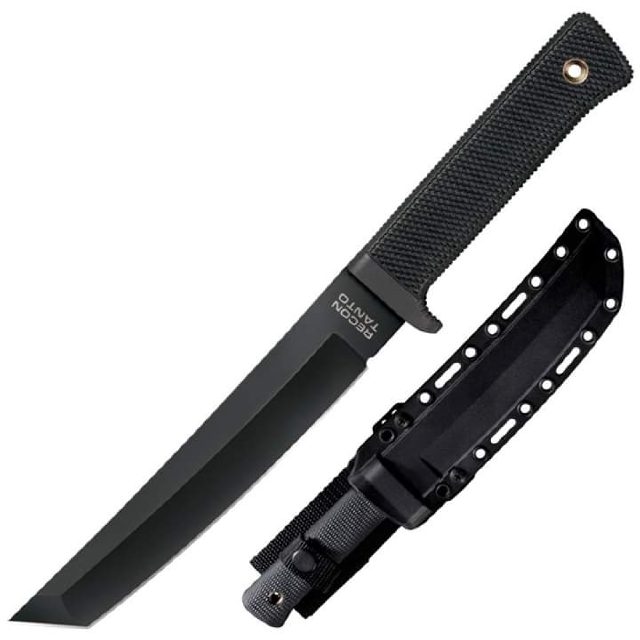
The knife I chose was the Cold Steel 49LRTZ Recon Tanto Fixed Blade. I wanted at least a 7" blade, because that’s the minimum length, according to my research, that you need to pierce the heart of a mountain line.
I carried it on my hip, which was an ideal location for weight, and also looked super neat.
I had also read some stories about strange situations on the trail where humans were a problem. The knife served as a deterrent to those type of folks.
Within the first hundred miles, I continued to drill daily, and only used the knife once to cut some tenacious tape to repair some holes in my down jacket.
Also, during the first 100 miles, I pushed myself to be more exposed to the supposed dangers of animals. I would keep vestibules open, stay out in the dark longer, etc. Although I had already known it intellectually, my heart began to understand that animals are not inherently a danger if you know how to act correctly. In addition, I began to develop an empathy for them that I had not experienced before - they used to have the entire natural ecosystem to wander and live, and now they have these relatively small areas that humans have locked them into. My heart goes out to the unfortunate situation they’re in, and quite frankly, I don’t want to ever kill a wild animal just because I did something wrong. That’s obnoxious.
I read a story about a man who was carrying a gun, and as a mountain lion ran towards him, he shot it. After the fact, the park rangers did not fault him for it, but honestly, a mountain lion doesn’t attack from the front, but rather the back. As it turns out, the lion was trying to get back to her kits. They found 2 kits, now abandoned, because the man was ignorant of how mountain lions operate, and his ignorance drove his fear to kill.
Everyone, and every thing, make mistakes. It’s an unfortunate situation.
But quite frankly. That situation was bull!@#$. A life was taken because that man didn’t know anything about the environment he was walking into.
There are 7 billion humans in the world, and an estimated 30,000 mountain lions. We don’t need to be killing them.
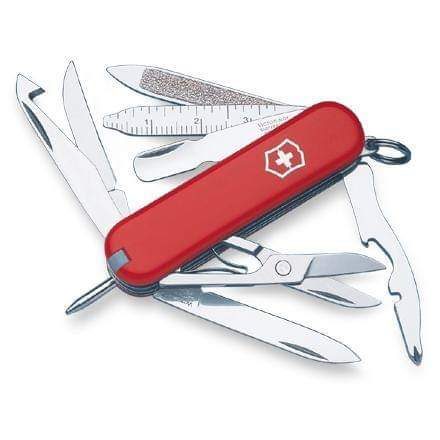
I left the knife at home when I returned to the trail after my ankle injury, saving 9 ounces of my base weight, not counting the sheath. I have no intention of battling any wild animal unless it is actively trying to tear me apart. Even then, I suspect I will be trying to deter it rather than kill it.
I returned with a Swiss Army Minichamp Knife. I used it to cut cheese.
I don’t know if it deters anyone.
Maybe the Swiss.
It was taken from me at the TSA checkpoint when I returned home, but I’m not really concerned. It did the job, but cheese tended to get stuck in the nooks.
I will be trying something new on subsequent hikes.
Next up, Rain gear, Cold gear, and Water kit…